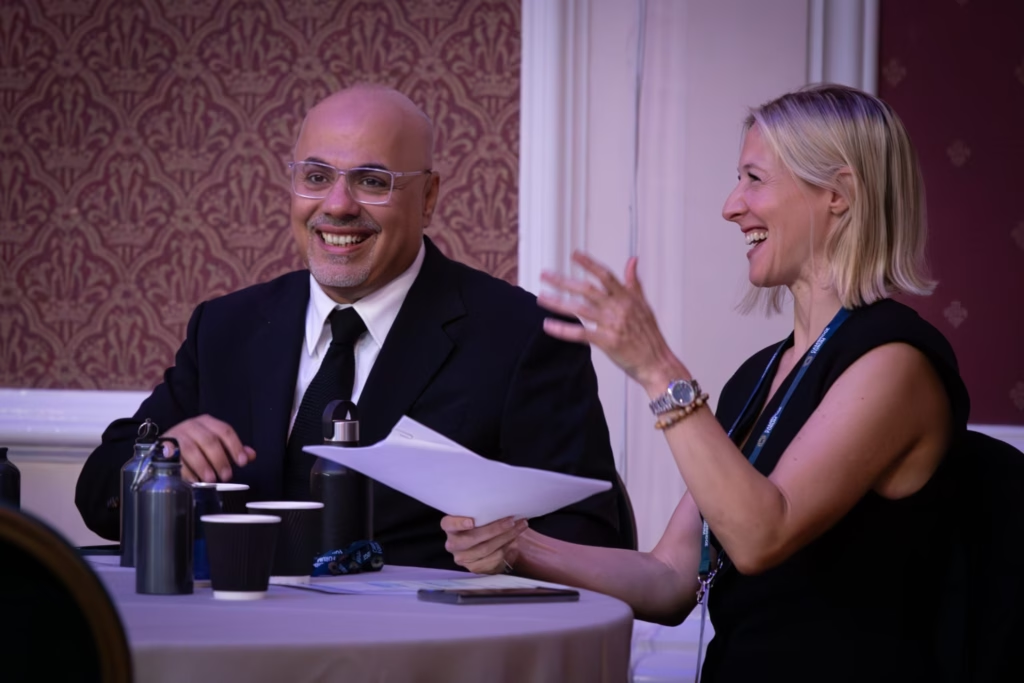
On 3rd September 2025, Dr Ehab Shanti delivered the opening address at the Cambridge Forum 2025, setting a dynamic and inspiring tone for the conference’s exploration of artificial intelligence, ethics, and the future of computational science. His remarks wove together the rich intellectual heritage of Cambridge with a forward-looking vision of AI as a force for positive human progress.
Honouring Cambridge’s Intellectual Roots
Dr Shanti began by paying homage to Cambridge’s historic contributions to computer science and artificial intelligence. He invoked two of the institution’s iconic figures: Alan Turing, whose pioneering work laid the foundations of computation, and Karen Spärck Jones, whose groundbreaking research in natural language processing firmly established the field’s modern trajectory. By linking these luminaries to the Forum’s ongoing mission, Dr Shanti underscored that today’s conversations rest on the shoulders of giants.
His message was clear: Cambridge is not merely a backdrop for AI discourse. It is a place whose very intellectual DNA is intertwined with the evolution of thinking machines.
Framing the Central Question: What Does It Mean to Build Intelligence?
Moving from historical reflection to present challenges, Dr Shanti posed a critical question: “What does it mean to build intelligence?” This is not merely a technical inquiry. It is a moral, philosophical, and societal one.
He outlined three axes along which this question must be addressed:
Capabilities
How do we define and measure intelligence in machines? How do we build systems able to reason, adapt, and learn in meaningful ways?
Alignment & Values
Intelligence without alignment can be dangerous. Dr Shanti emphasised the importance of embedding human-aligned values, ethics, and safety constraints into intelligent systems.
Impact on Humanity
Intelligence does not exist in a vacuum. It transforms societies. How can we ensure that AI advances contribute to human flourishing, equity, and well-being rather than exacerbating division or risk?
By framing the challenge in these three dimensions, Dr Shanti invited the audience to think broadly, not just about algorithms but about impact.
A Call for Interdisciplinary Dialogue
One of the most compelling themes in Dr Shanti’s address was the call for interdisciplinary collaboration. Technologists, philosophers, social scientists, ethicists, and policy makers must engage together. The complexities of AI are not purely engineering problems. They are deeply enmeshed with human values, legal systems, economics, and cultural norms.
He emphasised that no single discipline can fully anticipate or manage the cascading effects of powerful AI. The Forum, he suggested, is a space designed to bridge those divides.
Vision for an Inclusive AI Future
Dr Shanti’s optimism shone through in his vision of AI as a generative force for inclusion. He urged participants to strive to democratise access to intelligent systems, ensuring that the benefits of AI reach diverse communities, not just elite institutions or well-resourced nations. He also cautioned against concentration of power and opaque systems that exclude oversight or accountability.
His closing exhortation was simple and powerful: build intelligence that serves humanity, rather than overshadowing it.